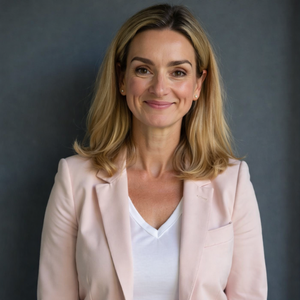
Patricia left an abusive marriage – and discovered a world of pleasure
Patricia left her marriage newly pregnant with her second child, with only her toddler and a washing machine, and no idea how she'd cope. She just knew staying wasn't an option.
Years later, she's found something many women living in survival mode may not know is possible: safety in her own body, and a different future for her daughters.
It's a pattern I see often in my work with women rebuilding their lives after divorce – but Patricia explains what's actually happening in the body more clearly than most.
In this article:
Patricia explains how she reached a point where she knew she had to leave her abusive marriage at six weeks pregnant, taking her daughter and the washing machine
The domestic violence cycle explained – honeymoon, tension, explosion, apology – and how it gets shorter and more intense over time
Patricia tells how building muscle for self-protection became the start of reconnecting with her body
Somatic practices and how they can help you feel safe in your body
A simple "pleasure menu" is something anyone can start today, wherever you are
What being "the good girl" cost Patricia
Patricia grew up with an emotionally unavailable mother and an unpredictable stepfather. She learned early that the safest thing to do was follow the rules, achieve, and not cause trouble. The more she achieved, the safer and more loved she felt.
That pattern followed her into adulthood. She became the strong one, the independent one, the person who was always doing. And when someone came along who love-bombed her – all-in, protective, intense – it felt like exactly what she'd been missing. That relationship became her marriage.
What a toxic marriage looks like from the inside
Looking back, Patricia says it was obvious to everyone else that the relationship was toxic. From the inside, it didn't feel that way – it felt like something to work on, something she could fix.
She describes the cycle clearly: a honeymoon phase where everything feels good, then tension, then an explosion, then an apology – "I didn't mean it," "I was drunk," or – eventually – "you made me do this." Then back to honeymoon. Over the years, the good periods got shorter. The explosions got worse.
What made Patricia realise she had to leave?
Patricia was six weeks pregnant with her second daughter when one of these explosions happened. She says that her husband crossed a line that day, endangering her unborn child’s life. She looked at her husband and felt nothing for him – "it was wiped away." She had tried to leave before and been pulled back.
This time was different.
She told him: "I'm going to take the washing machine and the children. I'm going to go."
It took a few months to get everything sorted but Patricia says the relief when she left was immediate. When she awoke on that first morning in her one-bedroom apartment, she opened the curtains to the sun rising over a lake, and she knew: this was going to be better.
Being from Germany, Patricia had no family support nearby, and not being a permanent resident, she had no access to government support. People around her questioned her choice to leave – she was pregnant, with a toddler, and no plan.
But Patricia knew there was no other option. She didn't want her daughters growing up in that house, and thinking that sort of relationship was okay. She was breaking the cycle for them.
How Patricia reclaimed her body
At first, the quiet was uncomfortable. The constant tension she'd lived with – the walking on eggshells – was suddenly gone, and that took some adjusting to.
Patricia knew she needed energy and focus. She got into fitness, specifically weightlifting – not for the way it looked, but because she wanted to be strong enough to protect herself if she was ever in physical danger again.
What she didn't expect was everything else that came with it. Feeling stronger in her body changed how she felt about herself. She started looking after her nutrition, trained as a fitness and nutrition coach, and began helping other women too – all from home, with her kids alongside her.
How Patricia reclaimed her mind
Patricia noticed that all that doing, doing, doing had a cost – her softness had disappeared. At a yoga class one day, she found herself crying through the entire session. That was the moment she knew there was more for her to explore.
From yoga came breathwork, meditation, and tantra. Patricia describes feeling more connected to her body than she ever had – including before the relationship. Out of that came the revelation of somatic pleasure: the felt experience of pleasure, not the performance of it.
The difference, Patricia explains, is presence. You can go through a ten-step self-care routine and still feel nothing if you're not actually there for it. Somatic pleasure is really tasting your food, feeling the stretch in a workout, noticing the sensation of the fabric on your skin as you’re getting dressed – actually being in your body while it happens.
What does "finding safety in your body" actually mean?
Patricia teaches a process she calls Pleasurelit Alchemy, and it starts with regulation – not pleasure. If your nervous system doesn't feel safe, pleasure isn't always accessible. So the first step is learning to regulate your nervous system and your emotions, so you can feel safe enough to actually feel.
She shares a recent example: at a children’s soccer game, a ball was accidentally kicked into her face, knocking off her glasses. Patricia’s body reacted immediately, taking her back to a moment during her marriage when her husband broke her nose – she started shaking and panicking.
Because of her alchemy practice, Patricia was able to talk herself through the experience, used breath to bring herself back to the present, and promising herself she would sit with the rest of the feelings when she was home in a safe space.
Later, in private, Patricia let herself fully feel the fear, anger and grief that came up, breathing through the feelings and using touch to help bring herself back into her body now. What started as a traumatic trigger event ended with Patricia feeling safe and comfortable – and with a self-pleasure session.
Patricia is clear this isn't about chasing an outcome. It's about allowing feelings to surface, and trusting that your body knows how to move through them.
How can you get started with somatic practice?
Patricia's first piece of advice is the most important: make sure you're safe. That's the foundation everything else sits on.
From there, she suggests something simple – create a pleasure menu. Take a piece of paper and write down what brings you joy, even in small ways. If it's hard to think of anything now, go back to childhood. What did you love doing before life got complicated? Drawing, dancing, singing in the car, a particular meal, the smell of rain.
Sort the list into small things (a song, a cup of tea in the sun) and bigger things (a massage, a haircut, a gap year in Europe). Keep your menu somewhere you can see it – or somewhere private, if that's safer – and each day, choose one or two things from it.
The list is a living, breathing document. You can change it as you evolve.
Want a free downloadable pleasure menu with ideas and space to fill in your own? You can grab one here.
Want to hear the full Divorce With Carolyn episode? You can listen here, or on your favourite podcast platform (Divorce With Carolyn episode 17).
Frequently asked questions
What is somatic pleasure?
Somatic pleasure is pleasure you actually feel in your body, in the moment – as opposed to going through the motions of self-care without being present for it. It applies to everyday things like eating, moving and getting dressed, not just intimacy.
What is Pleasurelit Alchemy?
It's the process Patricia teaches women, starting with nervous system and emotional regulation – building a sense of safety in the body – before working towards reconnecting with pleasure. You can learn more about it here.
Is pleasure just about sex?
No. Patricia is clear that somatic pleasure shows up in how you eat, move, dress, and go about ordinary parts of your day. Sex is one part of it, but certainly not the whole picture. And you can certainly practise somatic pleasure without it leading to sex.
What support services are available to women who want to leave a domestic and family violence situation?
1800RESPECT (Australia) — 1800 737 732, available 24/7
Lifeline Australia — 13 11 14
The Hotline (USA)
If you're outside these areas, search for your local domestic violence helpline, or contact emergency services if you're in immediate danger.